© https://www.dshs.texas.gov/
If you are exploring a career in emergency medical services, one of the first questions you will probably ask is simple:
What is the difference between an EMT and a paramedic?
An EMT provides basic emergency care and transport support, while a paramedic has more advanced medical training and a broader scope of practice. Texas regulates EMS personnel through the Texas Department of State Health Services, which oversees EMS certification and licensure statewide. (Texas Health Services) That is the short answer.
The bigger answer matters if you are deciding between EMT training and paramedic training in Houston, comparing career paths, or trying to understand what each role can legally do in the field.
Both EMTs and paramedics are essential in emergency response. Both can be part of ambulance crews, fire-based EMS systems, hospital transport teams, and disaster response. In Houston, pre-hospital emergency care and transportation are part of the City of Houston Fire Department’s public service mission. (City of Houston)
© https://www.dshs.texas.gov/
What does an EMT do?
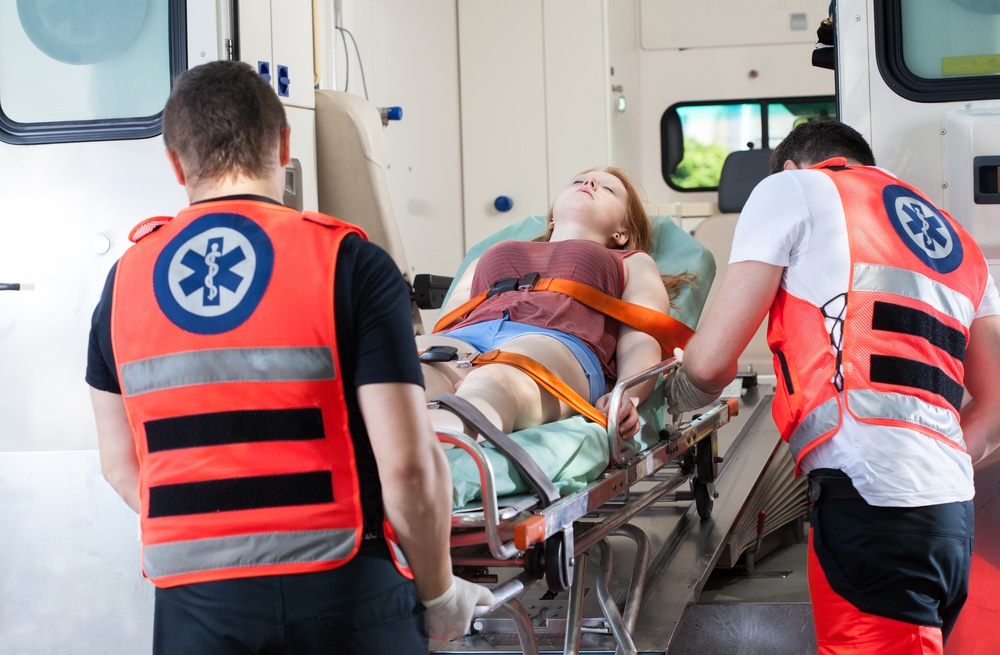
An EMT is usually the entry-level EMS professional who provides basic life support, patient assessment, and emergency transport support.
EMTs are often first on the scene. They help stabilize patients, support breathing and circulation, provide CPR when needed, and prepare patients for transport. Their work is practical, fast-moving, and crucial in the first minutes of an emergency.
For many people, EMT is the fastest path into emergency medical services because the role is designed as the foundation of the EMS ladder. Texas DSHS lists EMT as part of its EMS personnel certification and licensure structure. (Texas Health Services)
What does a paramedic do?
A paramedic provides advanced life support and can perform more complex medical interventions than an EMT.
Paramedics can do everything EMTs do, but their training goes much deeper. They are trained for more advanced patient care, including higher-level assessment, medication administration, and advanced interventions used in serious emergencies. Texas DSHS treats paramedic licensure as a higher clinical level within the EMS system. (Texas Health Services)
If the EMT role is the foundation, the paramedic role is the more advanced clinical tier.
Is a paramedic higher than an EMT?
Yes. A paramedic is a more advanced EMS role than an EMT.
This does not mean EMTs are less important. It means paramedics complete more extensive education and operate with a wider legal scope of practice. Many EMS professionals start as EMTs, gain field experience, and then move into Advanced EMT or paramedic training later.
Texas publicly separates EMS personnel levels and certification pathways through its EMS certification and licensure resources. (Texas Health Services)
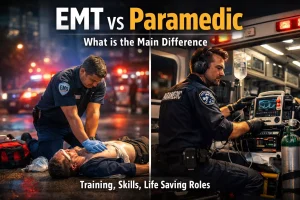
EMT vs paramedic: what is the main difference?
The main difference is training, scope of practice, and the level of medical responsibility in the field.
Here is the easiest way to think about it:
EMT
- Entry point into EMS
- Focuses on basic life support
- Handles patient stabilization and transport support
- Shorter training path
Paramedic
- Advanced EMS role
- Provides advanced life support
- Has broader clinical responsibilities
- Requires a much larger education commitment
That distinction is central to Texas EMS licensure and education pathways. (Texas Health Services)
© https://www.dshs.texas.gov/
How long does EMT training take in Texas?
EMT training takes much less time than paramedic training, which is one reason many people start there.
The exact length depends on the school, schedule, and program format. Some programs are faster, some are longer, and some are structured around evening or weekend coursework. What matters most is that EMT is the quicker entry point into the profession.
For official guidance on Texas EMS pathways, students should review the state’s EMS education and certification resources, including the Texas DSHS EMS Education Programs page and the Initial Certification and Licensure page. Texas also notes that candidates receive certification or licensure information through the DSHS process after completing the required steps. (Texas Health Services)
How long does paramedic training take in Texas?
Paramedic training takes longer because the coursework, clinical preparation, and field responsibilities are more advanced.
Becoming a paramedic is a bigger educational lift. It requires more time, more clinical depth, and more preparation for high-acuity patient care.
Texas DSHS oversees the licensure structure and directs candidates through official certification and exam pathways. For testing, Texas states that EMS certification and licensing exams for levels including EMT and paramedic are handled through the National Registry of Emergency Medical Technicians at Pearson VUE testing sites. (Texas Health Services)
You can review the official pages here:
Who makes more, EMTs or paramedics?
Paramedics usually earn more than EMTs because they have more advanced training and a broader scope of practice.
Exact pay depends on employer, shift structure, certifications, overtime, and public versus private EMS systems. Still, from a career-growth standpoint, paramedic training typically leads to more advanced responsibilities and stronger earning potential over time.
Texas also promotes EMS career development through its EMS Careers and Education page, which highlights scholarship support for individuals pursuing EMT, Advanced EMT, and paramedic training through licensed EMS providers. (Texas Health Services)
Can you become a paramedic without first becoming an EMT?
Paramedic education is built on EMS fundamentals, and EMT-level knowledge is part of that foundation.
Program structures can vary, but in practical terms, EMT training is commonly the first step people take before moving into paramedic-level work. Texas DSHS provides the official certification and licensure framework, so students should always confirm current requirements through the state before applying. (Texas Health Services)
What certifications do EMTs and paramedics need in Texas?
Texas EMS personnel must meet state certification or licensure requirements through the Texas Department of State Health Services.
That includes application steps, exam requirements, and final state processing. Texas also provides a live online verification tool for EMS certifications and licenses. (Texas Health Services)
Helpful official resources:
- Texas DSHS EMS Certification and Licensure
- Initial Certification and Licensure in Texas
- Live Online Certification and License Verification
- EMS Exam Information
What is the best EMS career path in Houston?
The best EMS path depends on how fast you want to enter the field and how advanced you want your long-term clinical role to be.
If you want a quicker starting point, EMT is usually the practical first move. If your goal is a broader medical scope and greater clinical responsibility, paramedic is the stronger long-term target.
For local context, Houston’s emergency response ecosystem includes fire-based EMS and public emergency management systems. The Houston Fire Department states that its services include prevention and enforcement, public education, pre-hospital emergency care and transportation, and fire control. Harris County also maintains emergency management and preparedness resources that help show the scale and structure of emergency response in the area. (City of Houston)
Useful local public links:
- Houston Fire Department
- Houston Fire Department Careers
- Harris County Office of Emergency Management
- Harris County Public Health Preparedness and Response
Should you choose EMT or paramedic?
Choose EMT if you want the faster entry point into emergency medical services. Choose paramedic if you want a more advanced clinical role.
A simple way to decide:
- Start with EMT if you want to enter the field sooner
- Aim for a paramedic if you want advanced life support responsibilities
- Use EMT as your stepping stone if you want a practical ladder into long-term EMS work
That is usually the cleanest path for students, considering speed, cost, and long-range opportunity.
Final answer: EMT vs paramedic
EMTs and paramedics both save lives, but paramedics receive more advanced training and carry a broader scope of practice.
That is the key difference.
If you are researching EMS careers in Houston or comparing Texas certification paths, the smartest move is to start with official public resources, understand the state licensing structure, and then choose the training path that fits your timeline and goals. Texas DSHS is the source of truth for EMS certification and licensing, and Houston public safety resources help show how those roles function in the real world. (Texas Health Services)
FAQ Section
What is the difference between an EMT and a paramedic?
An EMT provides basic emergency care and transport support, while a paramedic has more advanced training and a wider clinical scope.
Is a paramedic above an EMT?
Yes. A paramedic is a more advanced EMS role with more education and broader medical responsibilities.
How long does it take to become an EMT in Texas?
EMT training takes less time than paramedic training, though exact timelines vary by program.
How long does it take to become a paramedic in Texas?
Paramedic training takes longer because it includes more advanced coursework, clinical work, and field preparation.
Where can I verify EMS certification requirements in Texas?
You can verify current EMS certification and licensure requirements through the Texas Department of State Health Services. (Texas Health Services)
Author / Reviewer Byline
Written by Health Street Editorial Team
Reviewed by Leah F., Director