TL;DR What is MR.SOPA
MR.SOPA is a sequence of ventilation corrective steps used in NRP training when positive-pressure ventilation is not producing effective chest movement in a newborn. It stands for Mask adjustment, Reposition airway, Suction mouth and nose, Open mouth, Pressure increase, and Alternative airway. In simple terms, MR. SOPA helps healthcare providers fix the airway before the newborn’s condition gets worse. In neonatal resuscitation, ventilation is often the action that changes the outcome.
What is MR.SOPA in NRP?
MR.SOPA is a clinical memory tool used during newborn resuscitation when ventilation is not working as expected.
The letters stand for:
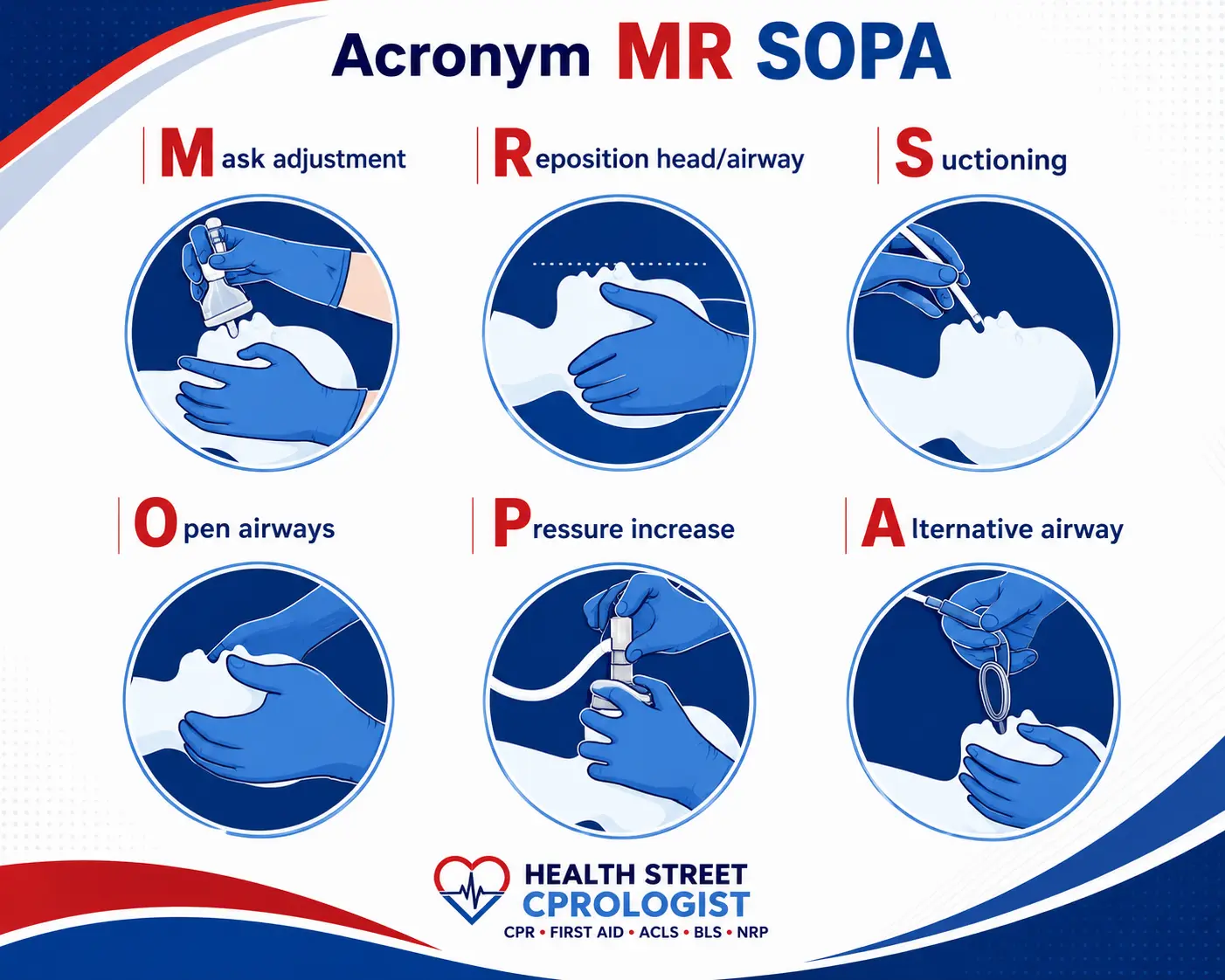
- M: Mask adjustment
- R: Reposition airway
- S: Suction mouth and nose
- O: Open mouth
- P: Pressure increase
- A: Alternative airway
MR.SOPA is not just a list to memorize. It is a decision pathway. It helps providers move from the most common ventilation problems to more advanced airway support.
Think of it like troubleshooting a locked door. Before breaking the door down, you check the key, the handle, the frame, and the lock.
In NRP neonatal resuscitation, the provider checks mask seal, airway position, secretions, mouth opening, pressure, and airway escalation.
Why Does MR. SOPA Matter in the NRP 9th Edition?
The NRP 9th Edition continues the Neonatal Resuscitation Program’s focus on evidence-based care for newborns at birth. According to the American Academy of Pediatrics, NRP 9th Edition aligns with updated AHA and AAP neonatal resuscitation guidance and integrates current research and best practices.
MR.SOPA fits that purpose because ineffective ventilation is one of the most important problems a delivery room team must correct quickly.
The physiology is simple.
If the newborn’s lungs are not receiving air, oxygen cannot move into the bloodstream.
If oxygen does not improve, the heart rate may not improve. MR. SOPA gives the care team a clear process for correcting ventilation problems before the situation escalates.
When Is MR. SOPA Used
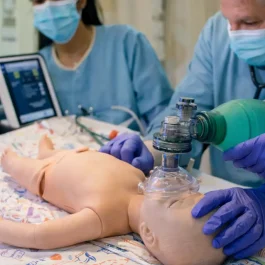
MR.SOPA is used when positive-pressure ventilation is started but the newborn’s chest is not moving effectively.
Common signs include:
- Poor or absent chest rise
- Mask leak
- Blocked airway
- Poor head or neck position
- Secretions in the airway
- Closed mouth during ventilation
- Low heart rate response after ventilation begins
- Continued ineffective ventilation despite initial attempts
In the NRP algorithm, ventilation quality matters because the team must quickly decide if the newborn is improving or if additional interventions are needed.
How does Mr. SOPA Fit Into the NRP Algorithm?
The NRP algorithm helps healthcare providers organize newborn resuscitation steps in a time-sensitive environment. MR. SOPA supports the ventilation portion of that process.
Here is the practical sequence:
- The provider begins positive-pressure ventilation when indicated.
- The team checks for visible chest movement and heart rate improvement.
- If ventilation is not effective, the provider applies MR. SOPA.
- The team reassesses chest movement and heart rate.
- If ventilation remains ineffective, the team considers advanced airway support and escalation.
The main idea is not speed alone. The goal is accurate action under pressure.
A team that understands MR. SOPA can communicate better during neonatal resuscitation. Instead of saying, “It is not working,” the team can name the next correction: adjust the mask, reposition the airway, suction, open the mouth, increase pressure, or prepare an alternative airway.
What Does Each MR. SOPA Step Mean?
Mask Adjustment
A poor mask seal can stop air from entering the lungs. The provider may need to reposition the mask, check hand placement, and make sure the mask is not leaking around the nose or chin.
Reposition Airway
The newborn’s airway must be positioned correctly. Too much flexion or extension can block airflow. Repositioning helps open the airway for better ventilation.
Suction Mouth and Nose
Secretions can block airflow. Suction may be needed when visible fluid, mucus, or obstruction affects ventilation.
Open Mouth
A closed mouth can reduce effective ventilation. Opening the mouth can help air move more effectively.
Pressure Increase
If earlier steps do not correct the problem, pressure may need to be increased according to provider training and course guidance.
Alternative Airway
If mask ventilation remains ineffective, the team may need to consider an alternative airway based on the situation, provider role, and clinical training.
Who Needs to Understand MR. SOPA?
MR.SOPA is important for healthcare professionals involved in newborn care at birth.
This may include:
- Labor and delivery nurses
- NICU nurses
- Respiratory therapists
- Physicians
- Midwives
- Nurse practitioners
- EMS and transport teams involved in neonatal emergencies
- Healthcare students preparing for newborn care roles
For students searching for NRP certification near me, NRP classes near me, or an NRP course near me, MR. SOPA is one of the concepts that can help connect classroom learning to real delivery room thinking.
Is MR. SOPA the Same as NRP Certification?
No. MR. SOPA is one concept inside neonatal resuscitation training. NRP certification or NRP course completion involves a broader learning pathway that may include online education, instructor-led skills practice, simulation, team communication, and newborn resuscitation decision-making. MR.SOPA supports one critical part of that training: correcting ineffective ventilation.
Quick FAQs
What does MR. SOPA stand for in NRP?
MR.SOPA stands for Mask adjustment, Reposition airway, Suction mouth and nose, Open mouth, Pressure increase, and Alternative airway.
What is MR. SOPA used for?
MR.SOPA is used to correct ineffective positive-pressure ventilation during neonatal resuscitation. It helps providers troubleshoot airflow problems when the newborn’s chest is not moving effectively.
Is MR. SOPA part of the NRP algorithm?
MR.SOPA supports the ventilation correction process within NRP training. It helps the care team improve ventilation before moving to additional interventions.
Who should take NRP training?
NRP training is designed for healthcare professionals who care for newborns at birth, including labor and delivery teams, NICU teams, respiratory therapists, physicians, midwives, and related clinical providers.
Where can I take NRP training in Houston?
Health Street CPRologist provides NRP training in Houston for healthcare professionals who need newborn resuscitation education and skills practice.
Schedule NRP Training in Houston
Need NRP training for your healthcare role or clinical team?
Health Street CPRologist helps healthcare professionals prepare for neonatal resuscitation with practical training, instructor support, and a clear class registration process.
NRP classes are filling for June 23rd and July 1st.
Only 4 students per class.
Times available: 10 AM, 12 PM, and 2 PM.
In-person training is just $109 to learn skills that can help save a life.
Seats are limited. Save your spot today:
https://cprologist.enrollware.com/enroll?course=465002
Health Street CPRologist
1710 S. Dairy Ashford Rd., Suite #207
Houston, TX 77077
Phone: (281) 920-9490
Text: (281) 713-4555
Email: info@cprologist.com
Author Bio

Written by Leah F., Operations Director at Health Street CPRologist. Leah supports American Heart Association course operations, student registration workflows, certification support, instructor coordination, and healthcare education content for Health Street CPRologist in Houston, Texas.