TL;DR RQI uses a kiosk and a computer to measure CPR skills. In-person CPR classes at Health Street CPRologist in Houston use live AHA instructors, team-based scenarios, and real code communication. Most learners feel more confident after a full in-person BLS, ACLS, or PALS class than after a quick RQI session with a machine.
What is RQI CPR training?
RQI stands for Resuscitation Quality Improvement. Many hospitals in Houston now use it for on-site American Heart Association updates.
Typical RQI process:
- You complete online modules on a computer
- You go to a kiosk inside the hospital
- You perform compressions and breaths on a manikin connected to sensors
- The system scores your depth, rate, and recoil
- The computer decides if you pass
RQI focuses on frequent, short refreshers with limited disruption to staffing. It solves some scheduling problems, although it creates new gaps in clinical readiness.
What do learners dislike about RQI?
When learners talk about RQI, the same complaints show up again and again.
Common pain points:
- No human instructor: there is no one to ask, “Would this match what our charge nurse expects?”
- No true team practice: codes rarely happen with one person and a kiosk, yet RQI is designed for solo use
- Little room for nuance: the algorithm is rigid, even when local policies or patient situations look different
- Box-checking feel: learners often feel they are completing a task for compliance, not actually growing in confidence
RQI can be helpful for basic psychomotor refreshers. It rarely replaces the depth of a full instructor-led course.
How is in-person CPR training different?
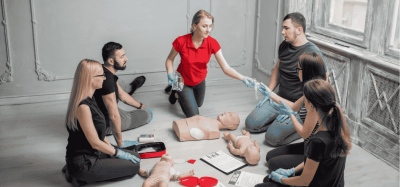
In-person CPR training at Health Street CPRologist uses official AHA course materials plus live instructors who have stood in real code rooms.
Key advantages:
- Real instructors, real stories
Instructors bring bedside experience from emergency departments, ICUs, EMS, and obstetrics. That context helps learners connect the algorithm to real patients. - Team-based scenarios
Learners practice as a compressor, airway, medications, recorder, and team leader, instead of staying alone at a kiosk. - Two-way coaching
You can ask about gray areas that never show up in canned videos, like delayed help, limited staff, or conflicting orders. - Psychological safety
Learners make mistakes in a safe space and correct them with guidance, instead of silently failing a machine test.
The same technology that powers RQI manikins can still be used in class. The difference is that data is paired with coaching, communication, and context.
Does in-person CPR training still meet AHA requirements?
Yes. Health Street CPRologist in Houston follows the current American Heart Association guidelines and uses approved BLS, ACLS, and PALS course materials.
When you pass:
- You receive an AHA eCard or digital certificate
- Your certification is accepted by hospitals and employers in Houston and across Texas
- You can report your training easily to managers, travel agencies, and credentialing offices
Learners who already use RQI inside a hospital often add an in-person course when they want deeper refreshers or are planning a role change.
When is an in-person CPR class the better choice than RQI?
In-person CPR training is the better option when:
- You feel nervous about responding to a real code
- You are starting a new role in the ICU, ED, cath lab, labor and delivery, or pediatric units
- You have never run code as part of the team
- You want to practice using your voice as a leader or recorder
- You are preparing for travel contracts or a promotion
RQI can keep the basics sharp. A live AHA course gives you the full rehearsal.

FAQ: RQI vs classroom CPR in Houston
Can I take an in-person CPR class if my hospital already uses RQI?
Yes. Many clinicians complete RQI for in-house policy and attend an AHA course at a local training site for a deeper reset.
Will AHA cards from Health Street CPRologist count for my job?
Health Street CPRologist issues official AHA BLS, ACLS, PALS, and NRP eCards. These are widely accepted by Houston hospitals, outpatient centers, and staffing agencies.
Are in-person CPR classes longer than RQI?
An RQI session may take minutes. A full AHA course takes several hours with skills practice and scenarios. The extra time buys stronger muscle memory and team skills.
If RQI leaves you feeling unprepared for the next code blue, schedule an in-person CPR class in Houston and rebuild your confidence with a live instructor.
Health Street CPRologist – CPR Training in Houston, Texas
1710 S. Dairy Ashford Rd., Suite #207, Houston, TX 77077
Phone: (281) 920-9490
Email: info@cprologist.com
Choose BLS, ACLS, PALS, or NRP and train with a human team that looks more like your real code room.
Reviewed by: Leah F., Operations Director, Health Street CPRologist.
Sign Up Today, Click Here!