A coworker suddenly becomes pale and dizzy. One person reaches for coffee. Another grabs ice. Someone else says never to use a tourniquet. Everyone wants to help, but outdated first aid advice can turn good intentions into added risk.
The safest response is not to memorize a random collection of tricks. It is to recognize the emergency, call 911 when needed, and use techniques that match current first aid and CPR guidance.
Important: Call 911 immediately for an unresponsive person, abnormal breathing, severe bleeding, severe choking, signs of stroke or heart attack, heatstroke, or any condition that appears life-threatening. This article is educational and does not replace hands-on training or instructions from emergency dispatchers.
TL;DR: What are the most common first aid mistakes?
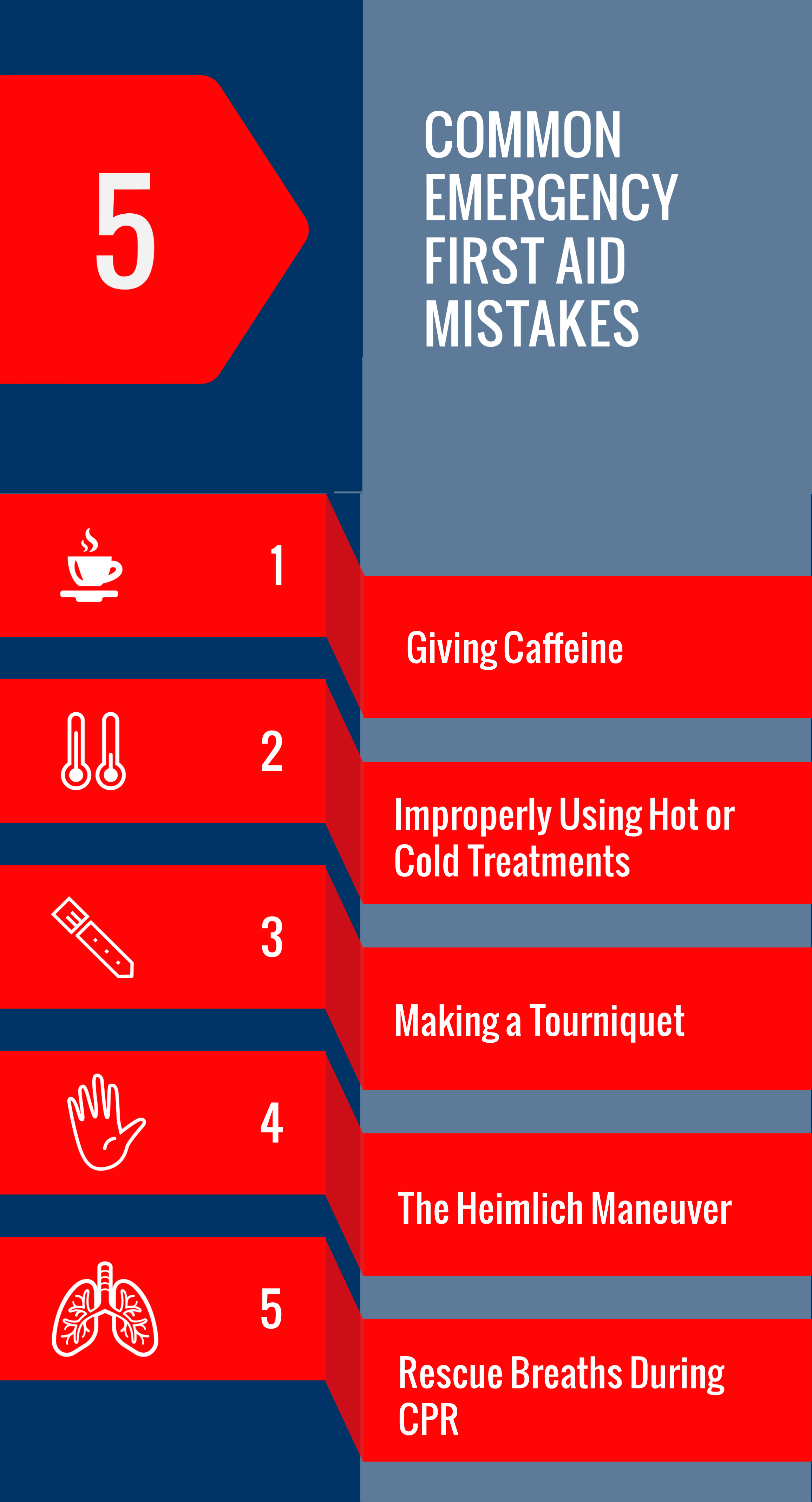
Five common first aid mistakes are giving food or drinks to someone who cannot swallow safely, placing ice directly on the skin, avoiding a tourniquet during life-threatening limb bleeding, using the wrong choking technique, and delaying CPR because you are unsure about rescue breaths.
- Giving a drink, food, or medication before checking whether the person is fully alert and able to swallow.
- Applying ice directly to the skin or using cold for too long.
- Believing a tourniquet should never be used for severe bleeding.
- Performing abdominal thrusts when a person can still cough effectively, or using the adult technique on an infant.
- Confusing a heart attack with cardiac arrest or waiting too long to begin CPR and use an AED.
What should you do first in an emergency?
Start by making sure the scene is safe, checking responsiveness and normal breathing, and activating emergency medical services when the condition may be serious. Ask someone to bring an AED and first aid kit when available. Give care within your level of training and follow the 911 dispatcher’s instructions.
Current American Heart Association and American Red Cross first aid guidance emphasizes provider safety, early recognition, appropriate emergency activation, and care that stays within the responder’s knowledge and skill level.
Mistake 1: Giving coffee, soda, food, or medicine without checking swallowing safety
Do not give anything by mouth to a person who is unconscious, confused, having a seizure, unable to stay awake, choking, or unable to swallow normally. Food, liquid, or medication can enter the airway and cause choking or aspiration.
The problem is broader than caffeine. A cup of coffee is not an emergency treatment, but automatically giving water can also be unsafe when the person’s alertness or swallowing ability is impaired.
What should you do instead?
- Call 911 for confusion, loss of consciousness, severe weakness, heatstroke symptoms, repeated vomiting, breathing difficulty, or failure to recover promptly.
- Place a person with decreased alertness who is breathing normally on their side when no traumatic injury is suspected, and monitor breathing until help arrives.
- For exertional dehydration or mild heat exhaustion, offer water or an electrolyte drink only when the person is fully alert and able to swallow.
- For suspected low blood sugar, oral glucose is appropriate only when the person is awake and able to swallow. Activate EMS if the person cannot swallow, has a seizure, or does not improve promptly.
A simple safety rule: If the person cannot protect their own airway, give nothing by mouth.
Mistake 2: Applying ice or heat incorrectly
Cold therapy may help reduce pain and swelling after a fresh sprain, strain, bruise, or other soft-tissue injury. The mistake is putting ice directly on the skin, leaving it in place too long, or assuming every injury needs the same treatment.
How should you use a cold pack?
- Wrap the cold pack or bag of ice and water in a thin towel.
- Apply it for no more than about 20 minutes at a time.
- Remove it sooner if the area becomes very painful, numb, pale, blue, or unusually cold.
- Do not use heat immediately on a new injury with swelling or suspected internal bleeding.
Burns require a different response. Cool a thermal burn promptly with clean running water, generally for 5 to 20 minutes. Do not press bare ice onto a burn. Seek prompt medical evaluation for deep burns, burns larger than the person’s palm, burns involving the face, hands, feet, or genitals, and any signs of smoke inhalation.
The 2024 first aid guidelines support clean running water for thermal burns and recommend a barrier between cold therapy and the skin for soft-tissue injuries.
Mistake 3: Believing tourniquets should never be used
The advice to avoid tourniquets in every situation is outdated and potentially dangerous. A manufactured tourniquet can be lifesaving for life-threatening bleeding from an arm or leg. Current guidance supports prompt tourniquet use for severe extremity bleeding when the responder has the device and knows how to use it.
What counts as life-threatening bleeding?
- Blood that is flowing continuously or spurting.
- A large amount of blood collecting on the ground or soaking through clothing or dressings.
- Partial or complete amputation.
- Bleeding accompanied by weakness, confusion, pale or clammy skin, or other signs of shock.
What should you do instead?
- Call 911 and apply firm direct pressure immediately.
- For life-threatening bleeding from an arm or leg, apply a manufactured tourniquet according to your training and the device instructions.
- For severe bleeding where a tourniquet cannot be used, continue direct pressure and use wound packing or a hemostatic dressing if trained and equipped.
- Once a tourniquet has stopped life-threatening bleeding, do not loosen or remove it. Note the application time and tell EMS.
Do not use a tourniquet for minor cuts. The key distinction is whether the bleeding is life-threatening, not whether tourniquets are always good or always bad.
The American Heart Association and American Red Cross recommend direct pressure for open bleeding and support manufactured tourniquets as first-line care for life-threatening extremity bleeding.
Mistake 4: Using the wrong choking response
Do not begin abdominal thrusts simply because someone coughs during a meal. If the person can speak, breathe, or cough forcefully, encourage continued coughing and watch closely. Intervene when the airway obstruction is severe and the person cannot speak, breathe, or cough effectively.
What is the correct first aid for severe choking?
- For a conscious adult or child: Alternate 5 back blows with 5 abdominal thrusts, sometimes called the Heimlich maneuver, until the object is expelled or the person becomes unresponsive.
- For a person in late pregnancy or someone whose abdomen you cannot encircle: Use 5 back blows followed by 5 chest thrusts.
- For an infant: Alternate 5 back blows with 5 chest thrusts. Do not use abdominal thrusts on an infant.
- Do not perform a blind finger sweep. Remove an object only when you can see it clearly.
- If the person becomes unresponsive: Lower them safely, call 911 or send someone to call, get an AED, and begin CPR starting with chest compressions.
The 2025 American Heart Association CPR guidelines updated choking care for conscious adults and children to cycles of 5 back blows followed by 5 abdominal thrusts.
Mistake 5: Confusing a heart attack with cardiac arrest or delaying CPR
A heart attack and cardiac arrest are not the same emergency. A person having a heart attack is often awake and breathing. A person in cardiac arrest is unresponsive and is not breathing normally, or may only be gasping.
For possible heart attack symptoms, call 911, keep the person at rest, and monitor them. Start CPR only if the person becomes unresponsive and is not breathing normally.
What type of CPR should a bystander use?
- For an untrained bystander who sees a teen or adult suddenly collapse, Hands-Only CPR means calling 911 and giving continuous chest compressions until an AED or professional help arrives.
- A trained rescuer may provide conventional CPR with chest compressions and rescue breaths.
- Rescue breaths are especially important when cardiac arrest follows a breathing emergency, including drowning, and for infants and children.
- Use an AED as soon as it is available and follow its spoken prompts.
Do not lose critical time debating which technique is perfect. Activate 911, begin the CPR method you know, and use the AED.
Learn more about when to perform CPR and how an AED supports cardiac arrest response through Health Street CPRologist resources.
When should you call 911 during a first aid emergency?
Call 911 whenever the person has a life-threatening condition or you are unsure how serious the emergency may be. High-risk warning signs include:
- Unresponsiveness, confusion, seizure, or sudden collapse.
- Absent or abnormal breathing, including gasping.
- Severe or uncontrolled bleeding.
- Severe choking or inability to speak, breathe, or cough.
- Chest pressure, signs of stroke, or sudden severe breathing difficulty.
- Heat illness with altered mental status.
- Major trauma, suspected spinal injury, deep burns, smoke inhalation, or rapidly worsening symptoms.
Quick emergency first aid checklist
- Make sure the scene is safe before approaching.
- Check responsiveness and normal breathing.
- Call 911 early when the condition is serious or uncertain.
- Send someone for an AED and first aid kit.
- Give care within your training and follow dispatcher instructions.
- Continue monitoring breathing, responsiveness, and bleeding until EMS takes over.
Frequently asked questions about first aid mistakes
What is the biggest first aid mistake?
One of the most dangerous mistakes is delaying 911 while trying home remedies or waiting for symptoms to improve. Early emergency activation matters when a person is unresponsive, not breathing normally, choking severely, bleeding heavily, or showing signs of heart attack, stroke, or heatstroke.
Should you give water to someone who fainted?
Not immediately. First check breathing and responsiveness. A person who is confused, very drowsy, vomiting, or unable to swallow should receive nothing by mouth. Fluids may be offered only after the person is fully alert, can swallow safely, and does not have another condition requiring emergency care.
Is a tourniquet dangerous?
A tourniquet can cause harm if used unnecessarily or incorrectly, but uncontrolled life-threatening bleeding can cause death within minutes. For severe bleeding from an arm or leg, a properly applied manufactured tourniquet can be lifesaving.
Should you perform the Heimlich maneuver if someone is coughing?
Not when the person can cough forcefully, speak, and breathe. Encourage coughing and watch closely. Use the recommended severe-choking sequence when the person cannot cough effectively, speak, or breathe.
How long should you leave ice on a sprain?
Use a wrapped cold pack for no more than about 20 minutes at a time. Never place ice directly on the skin, and stop sooner if the skin becomes numb, pale, blue, or painfully cold.
When are rescue breaths recommended?
Trained rescuers may use CPR with compressions and breaths. Breaths are particularly important for infants, children, drowning victims, and cardiac arrests caused by a breathing problem. Hands-Only CPR remains an important option for untrained bystanders who witness a teen or adult suddenly collapse.
Practice the right response before an emergency happens
First aid confidence should come from practice, not from remembering advice you heard years ago. Health Street CPRologist offers American Heart Association Heartsaver First Aid, CPR, and AED training in Houston for parents, teachers, caregivers, coaches, workplace teams, and community members.
Choose the class that matches your needs and practice how to recognize an emergency, control severe bleeding, respond to choking, perform CPR, and use an AED before those skills are needed in real life.
Explore First Aid and CPR classes in Houston
View Heartsaver First Aid, CPR, and AED class options
Be prepared to recognize the danger, avoid the common mistake, and take the next right action while professional help is on the way.
Medical disclaimer
This article is for general education and does not replace professional medical advice, hands-on first aid or CPR training, instructions from a 911 dispatcher, or local emergency protocols. Call 911 in the United States for a life-threatening emergency.